How Shockwave Therapy Helps Musculoskeletal Conditions
Introduction
Chronic musculoskeletal pain has a particular quality that patients describe almost universally: it's not dramatic, it just doesn't stop. A shoulder that aches through the night. A heel that takes twenty steps to loosen up each morning. A tendon that flares every time you try to return to sport. These aren't catastrophic injuries — they're conditions that wear people down slowly, because the tissue refuses to complete the repair process it started months ago.
This is where shockwave therapy for musculoskeletal pain enters the picture. Not as a painkiller, not as a temporary patch — but as a treatment that engages directly with the biology of the damaged tissue and gives it a reason, at the cellular level, to finally move forward. Here's what that actually means.
The Real Problem With Chronic Musculoskeletal Injuries
Most people assume that chronic musculoskeletal pain means ongoing inflammation. In reality, tissue that has been painful for three months or more has usually passed beyond the inflammatory phase entirely. What's left behind is a state of failed repair — disorganised collagen fibres, poor local blood supply, an accumulation of nerve endings in the wrong places, and a cellular environment that's stalled between injury and recovery.
This explains why anti-inflammatory medications and steroid injections often disappoint in chronic cases. There isn't active inflammation to suppress. What the tissue needs is a genuine biological signal to restart repair — and that's precisely what shockwave therapy delivers.
What Shockwave Therapy Does Inside the Tissue?
ESWT or Extracorporeal Shock Wave Therapy — uses focused acoustic pressure waves delivered through the skin into the target tissue. These aren't the low-energy waves used in diagnostic ultrasound. They carry enough mechanical force to trigger a cascade of biological responses deep within tendons, fascia, bursae, and muscle attachments.
The extracorporeal shockwave therapy benefits operate on several levels simultaneously. Tenocytes — the cells that produce and maintain tendon structure — are stimulated to synthesise new collagen, laid down with improved alignment along lines of mechanical stress. Growth factors, including TGF-beta1 and VEGF, are upregulated, reissuing the biological signals for tissue repair that had effectively gone quiet.
New capillaries form in under-perfused zones, improving nutrient and oxygen delivery to tissue that has been starved of both. And Substance P — the neuropeptide responsible for chronic pain signalling in sensitised tissue — is measurably reduced, which is why many patients notice genuine pain relief within the first two to three sessions, before the structural repair is anywhere near complete.
What are the Conditions That Respond Best to ESWT?
The range of musculoskeletal conditions with strong clinical evidence for shockwave treatment is broader than most patients realise. The most consistently well-evidenced applications include:
- Plantar fasciitis: chronic heel pain at the fascia insertion; success rates of 65–80% in cases resistant to physiotherapy
- Achilles tendinopathy: both mid-portion and insertional; especially effective when calcification is present
- Calcific rotator cuff tendinitis: ESWT disperses calcium deposits that nothing else non-surgical can reliably clear
- Patellar tendinopathy: strong outcomes when combined with progressive loading rehabilitation
- Lateral epicondylalgia (Tennis Elbow): outperforms steroid injection at 12-month follow-up in multiple RCTs
- Greater trochanteric pain syndrome: gluteal tendinopathy at the hip; increasingly well-evidenced
Across all these presentations, the pattern holds: shockwave therapy for musculoskeletal pain performs best when the condition has been present for at least three months and has not resolved with standard conservative care.
What Does a Course of Treatment Involve?
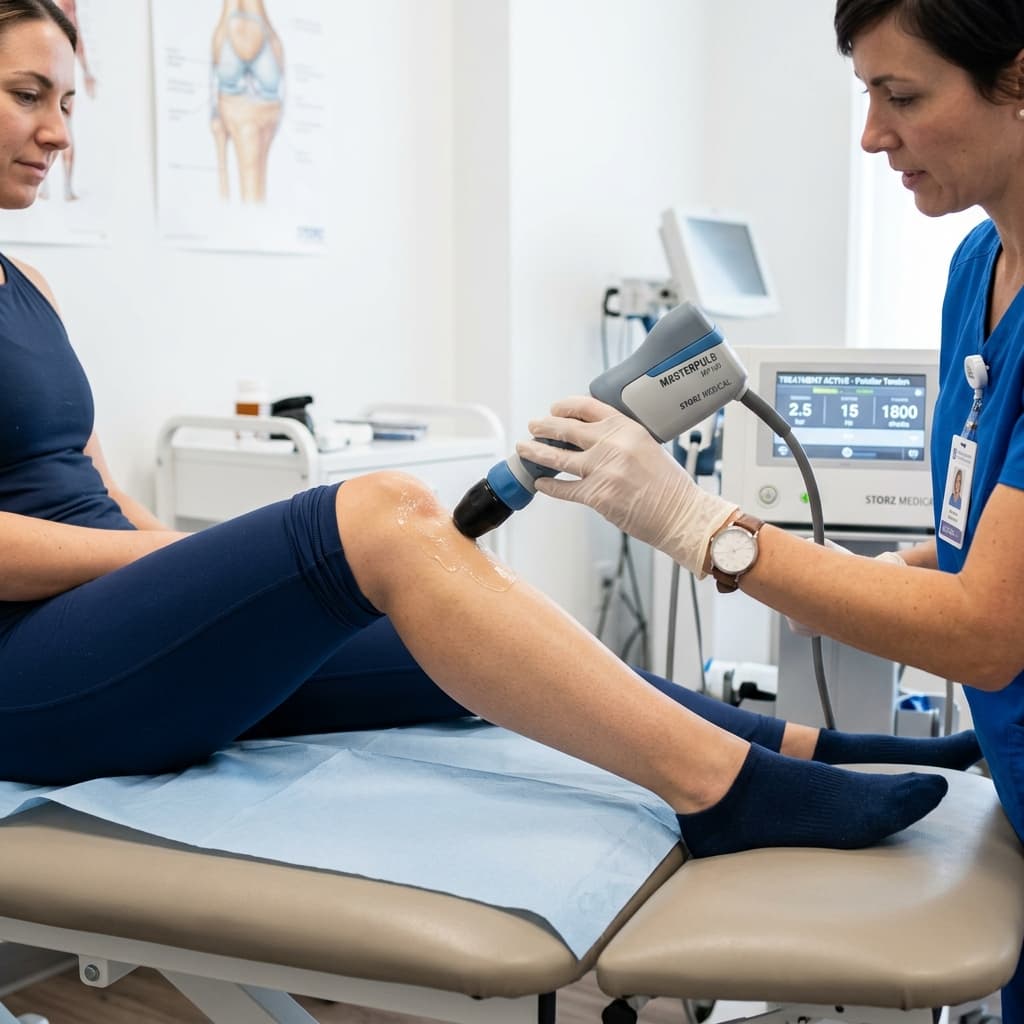
A standard shockwave therapy protocol for chronic pain runs three to five sessions, spaced a week apart, with each session lasting around 15 to 20 minutes. Coupling gel is applied to the skin, and a handheld probe delivers rhythmic pulses to the symptomatic area — no needles, no anaesthesia, no recovery period.
Two things patients are rarely told beforehand: avoid NSAIDs during the treatment course, because anti-inflammatory drugs suppress the biological response ESWT is designed to trigger. And expect the full benefits to take 8 to 12 weeks to develop after the final session — the tissue remodelling that underpins shockwave therapy for chronic pain continues long after the probe goes away.
Why Combining Shockwave Therapy With Rehabilitation Works Better?
ESWT used in isolation produces good results. ESWT used alongside a structured physiotherapy loading programme produces better outcomes consistently, across diagnosis types.
The rationale is straightforward: shockwave therapy changes the biological state of the tissue, making it capable of adapting to load. Physiotherapy teaches the body to load that tissue correctly, correcting the movement and strength deficits that contributed to the injury in the first place. One without the other leaves part of the problem unaddressed. Together, the extracorporeal shockwave therapy benefits become both more immediate and more durable over time.
Conclusion
Chronic musculoskeletal pain doesn't resolve through rest alone — and it rarely responds to treatments designed for acute injury.
Shockwave therapy for musculoskeletal pain, extracorporeal shockwave therapy benefits, and targeted shockwave therapy for chronic pain protocols offer something genuinely different: a non-invasive, evidence-backed route to tissue repair for conditions that have been stuck for months.
Talk to a qualified clinician about whether ESWT is appropriate for your treatment plan.
FAQs
Q: How soon will I feel improvement after shockwave therapy?
A: Many patients notice reduced pain after the second or third session. Full structural benefits develop over 8 to 12 weeks post-treatment as tissue remodelling continues.
Q: Can I have shockwave therapy if I've recently had a steroid injection?
A: Wait at least six weeks after a steroid injection before starting ESWT. Steroids temporarily weaken peritendinous tissue, and proceeding too early increases procedural risk.
Q: Is shockwave therapy painful during the session?
A: Mild to moderate discomfort over the most degenerated tissue is normal and expected. Practitioners adjust intensity throughout. Most patients describe it as tolerable, and the session is short.
Q: Does shockwave therapy work for muscle pain, or only tendons?
A: While the strongest evidence base centres on tendinopathy and fascial conditions, ESWT is also used effectively for myofascial trigger points and chronic muscle insertion pain with good clinical results.
Q: How many sessions will I need in total?
A: Most conditions respond to three to five sessions. Your clinician will reassess after the initial course — some presentations, particularly severe calcifications, may benefit from an additional one or two sessions.